Where flat roofs show up on older San Antonio houses
In neighborhoods like Castle Hills, Highland Park and Jefferson, many homes from the 1940s through the 1960s were extended over the years. Additions were often framed with a much shallower pitch than the main roof, sometimes just enough to shed water. A few midcentury modern homes were designed with low-slope roofs from the start.
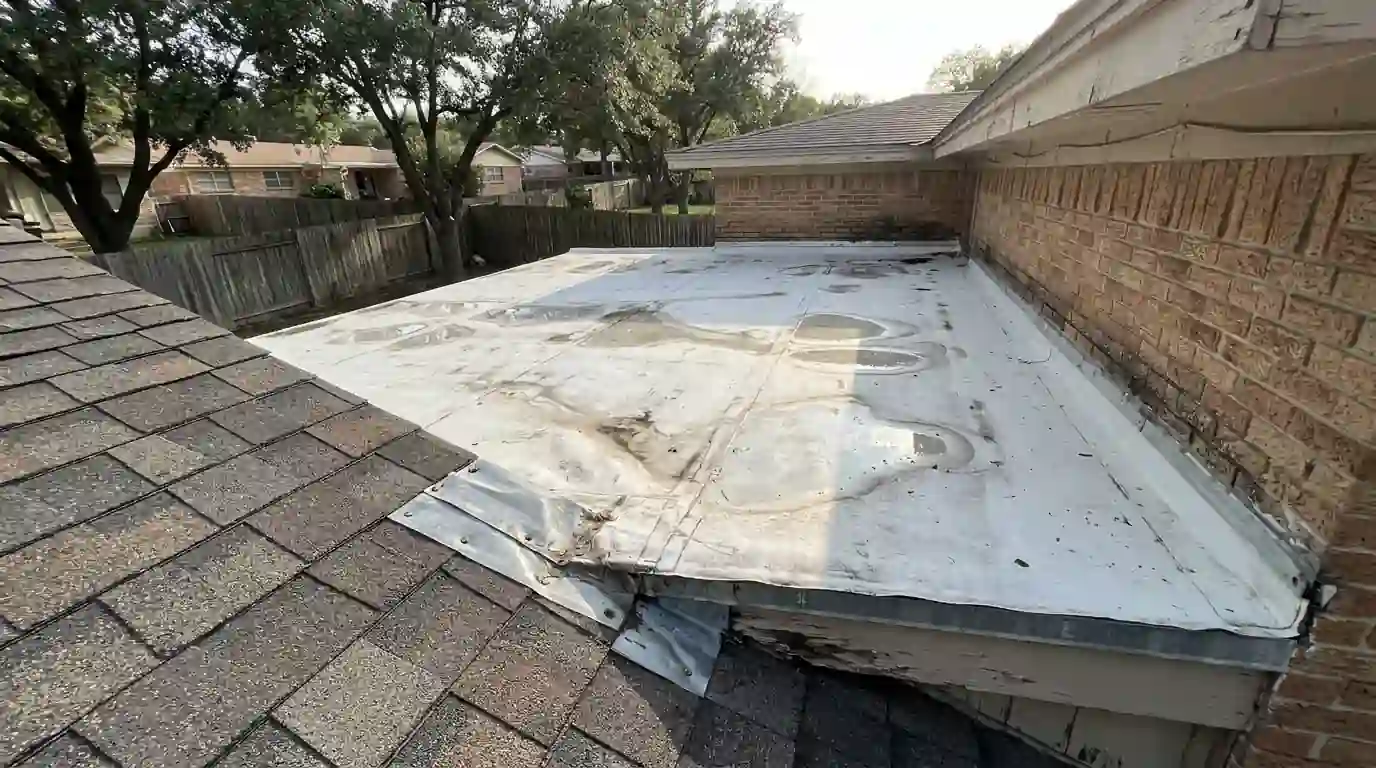
These sections usually aren't truly flat. Most have a slight slope toward a gutter, scupper or drain. When framing sags or the original slope was too shallow, water sits in low spots instead of running off, and that standing water is where most problems begin.
Older flat sections were commonly built up with layers of felt and hot asphalt topped with gravel, or covered with rolled roofing. If yours still has either, it has likely passed its useful life and is due for a different system.
Why low-slope roofs struggle in South Texas
Sun and heat are the main enemies. Dark roll roofing and old built-up roofs absorb heat all summer, dry out and crack. Expansion and contraction between hot afternoons and cooler nights work seams open over time, especially where the flat section meets the wall of the original house.
Heavy downpours are the other problem. A short, intense storm can drop more water than a small scupper or clogged gutter can carry, so water backs up and finds any weak seam. Live oak leaves and tassels clog drains fast in spring, which makes ponding worse.
- Ponding water that stays more than a day or two after rain.
- Blisters or bubbles in the membrane or roll roofing surface.
- Cracked or open seams, especially at the wall line.
- Stains on the ceiling under the addition or porch.
- Soft spots when you walk on it, which point to wet decking below.
TPO membrane: reflective and clean
TPO is a single-ply membrane, usually white, laid over insulation board and heat-welded at the seams. The welded seams fuse into one continuous sheet, which helps on roofs where seams were the weak point before. Its light surface reflects much of the sun's heat, a real benefit on a low roof sitting over a living space.
TPO works well on most residential low-slope sections, and it's a common choice when we replace an old built-up roof. Installed TPO roofing typically runs about $715 to $1,145 per square, with the final figure set by size, insulation choices and how much decking needs work.
It's worth knowing that TPO can be punctured by dropped tools or heavy foot traffic, so it isn't ideal if the roof doubles as an access route to HVAC equipment.
Modified bitumen: tough and detail-friendly
Modified bitumen is an asphalt-based roll membrane with rubber or plastic modifiers that keep it flexible. It comes in torch-applied and self-adhered versions, and the top cap sheet is usually granulated to protect it from the sun. It's thicker than TPO and handles foot traffic better.
On older homes with many penetrations, odd angles or tie-ins to the main roof, modified bitumen systems often make detail work easier. Self-adhered versions avoid open flame, which matters on wood-framed additions next to the original house. A lighter granule color helps with heat, though it won't reflect as much as white TPO.
When a silicone coating makes sense, and when it doesn't
A silicone coating is a liquid-applied layer sprayed or rolled over an existing roof. It creates a seamless, reflective surface that holds up well to standing water. On the right roof, it can add years of service without a full tear-off.
The key phrase is the right roof. A coating only works over a membrane that's still attached and decking that's dry. If the existing roof is soaked or the deck is rotten, coating it just seals the moisture in. We test adhesion and check for wet areas before recommending a silicone restoration.
Coatings also make later repairs harder, because few materials stick to cured silicone except more silicone. If you expect to replace the section within a few years anyway, a coating may not be the better spend.
Fixing drainage before choosing a material
No membrane lasts long if water sits on it for days. Before replacing a low-slope section, we look at how water is supposed to leave the roof and why it isn't. Small changes in slope or drainage often matter more than the brand of membrane.
Most of these fixes happen during replacement, when the old roof is off and the deck is exposed. For smaller trouble spots on a roof that still has life, targeted low-slope repair at seams and edges may be enough for now.
- Tapered insulation adds slope under the new membrane to push water toward drains.
- Wider scuppers or added drains help during heavy downpours.
- Replacing sagging decking removes low spots where water collects.
- Cricket framing redirects water away from the wall where the addition meets the house.
- Clear gutters and downspouts keep water moving off the edge.
How the flat section ties into the rest of the roof
The most common leak point we find isn't in the middle of a flat roof. It's the joint where the low-slope section meets the main roof or an exterior wall. Older additions were often tied in with little more than tar and a strip of metal, and that joint opens with years of movement.
A proper tie-in uses flashing that laps correctly behind the wall finish, membrane turned up the wall, and counter-flashing to cover the edge. On stucco or stone walls, that may mean opening part of the finish so the flashing sits behind it rather than being caulked on top.
If you're not sure what's on your flat section, ring our line at (210) 750-1898. We answer 24/7, and we'll check the surface, the drainage and the tie-in before recommending a system.